
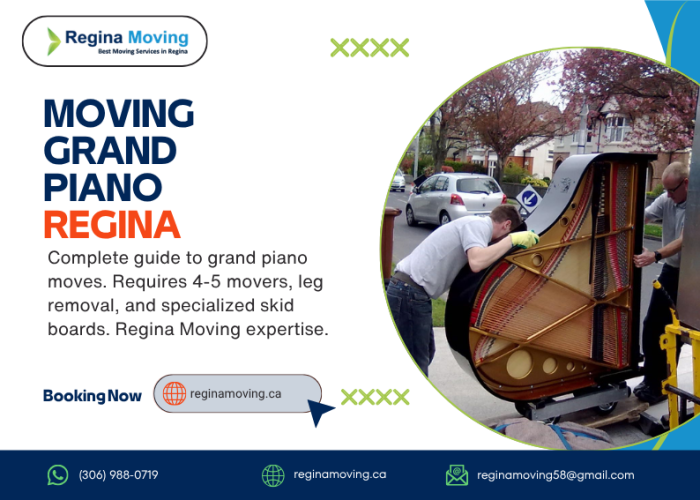
A grand piano is a statement piece—beautiful, sonorous, and often the heart of a home or performance space. But when it’s time to move that grand piano, everything changes. You can’t just tilt it onto a dolly and roll it out. Moving grand piano Regina requires a specific process, the right number of crew members, and equipment designed for the unique shape and weight of a grand.
At Regina Moving, we’ve moved hundreds of grand pianos—baby grands, mediums, and concert grands—with a perfect zero‑claim record. In this guide, we’ll walk you through why grand pianos are different, the step‑by‑step process we use, what costs to expect, and how we handle the trickiest scenarios like stairs.
To know more about moving different piano types visit our complete guide
Why Grand Pianos Require Special Handling
A grand piano isn’t just a larger version of an upright. Its construction and weight distribution make it a completely different moving challenge.
- Weight: Ranges from 500 lbs for a small baby grand to over 1,200 lbs for a concert grand.
- Shape: Long and low, with legs that stick out—those legs must come off for transport.
- Equipment: We use a skid board (a reinforced platform) to support the piano on its side, plus specialized leg‑removal tools.
- Crew size: A grand piano move requires a team of 4 to 5 trained movers, not just for the weight but for the coordination needed to angle it through doorways.
In Regina, we frequently move grand pianos from homes in the Cathedral area, from churches, and from music venues like the Conexus Arts Centre. Every move starts with the understanding that a grand piano is a precision instrument—not a piece of furniture.
Step‑by‑Step: How Professionals Move a Grand Piano
Here’s the exact process we follow for every grand piano move.
Step 1: Assessment
We visit your location to measure doorways, hallways, staircases, and the truck loading area. We also inspect the piano for any pre‑existing condition.
Step 2: Preparation
We remove the bench and any decorative music rack. The lid is locked or carefully padded to prevent it from opening during the move.
Step 3: Leg Removal
Each leg is unscrewed with care. We wrap each leg separately in padding and label them for reassembly.
Step 4: Skid Board Placement
The piano is gently tilted onto its side and placed onto a custom skid board. The board is designed to cradle the piano’s curved body, distributing weight evenly.
Step 5: Strapping and Padding
Heavy‑duty straps secure the piano to the skid board. We add extra padding at all contact points to protect the finish.
Step 6: Moving
The skid‑boarded piano is wheeled on a low‑profile dolly. If stairs are involved, we transition to stair rollers. The crew moves in coordinated steps, with one person guiding the angle.
Step 7: Loading
In the truck, the piano is positioned upright (on its skid board) and secured with straps to prevent any shifting during transit.
Step 8: Unloading and Reassembly
At the destination, the process is reversed. The piano is carefully placed, the legs are reattached, and we position it exactly where you want it.
Grand Piano Moving Costs – What to Expect
Costs vary based on piano size, distance, and whether stairs are involved. Below are typical ranges for Regina Moving quotes. We provide transparent, all‑inclusive quotes after an in‑home assessment—no hidden fees.
| Grand Piano Type | Local (ground level) | With Stairs | Long Distance |
| Baby Grand | $250 – $400 | $300 – $500 | $600 – $900 |
| Medium Grand | $300 – $500 | $400 – $700 | $800 – $1,200 |
| Concert Grand | $500 – $800 | $700 – $1,200 | $1,500 – $3,000+ |
Note: These are estimates. Exact pricing depends on access, number of stairs, and distance.
Moving a Grand Piano on Stairs – Extra Care Required
Stairs add a layer of complexity to any piano move, but with a grand piano it’s even more critical. The skid board keeps the piano stable, but navigating stairs requires additional equipment and crew.
Our stair process for grand pianos:
- Stair rollers: We place the skid‑boarded piano onto a set of stair rollers—essentially a track system that lets us walk the piano up or down one step at a time.
- Crew positioning: Four to five movers are positioned above and below to manage weight distribution.
- Railing protection: We pad banisters and walls to prevent scuffs.
If your grand piano is upstairs, we include the stair work in your quote upfront. No per‑flight surprises. For a deeper look at stair‑specific challenges, see our guide to moving pianos on stairs .
Trust Regina Moving with Your Grand Piano
Your grand piano deserves more than a couple of friends with a truck. It deserves a team that understands the engineering, the equipment, and the patience required to move it safely. Regina Moving has the experience—hundreds of grand pianos moved, zero claims—and we’re ready to put that experience to work for you.
Call us today for a free in‑home assessment. We’ll measure, plan, and give you a firm quote.
[Get Your Free Grand Piano Moving Quote]
Frequently Asked Questions
How many movers are needed for a grand piano?
A minimum of four trained movers; five for larger grand pianos or those involving stairs.
Do you have to remove the legs?
Yes. Legs must be removed for safe transport and to allow the piano to fit through doorways.
Can a grand piano be moved in one piece?
No—the legs must come off, and the piano is placed on a skid board. The lid and music rack may also be secured separately.
How long does a grand piano move take?
A local move typically takes 2 to 4 hours from start to finish. Long‑distance moves can take 1 to 7 days depending on distance and route.
Does Regina Moving have experience with concert grands?
Absolutely. We’ve moved concert grands for churches, concert halls, and private residences across Regina and Saskatchewan.
