
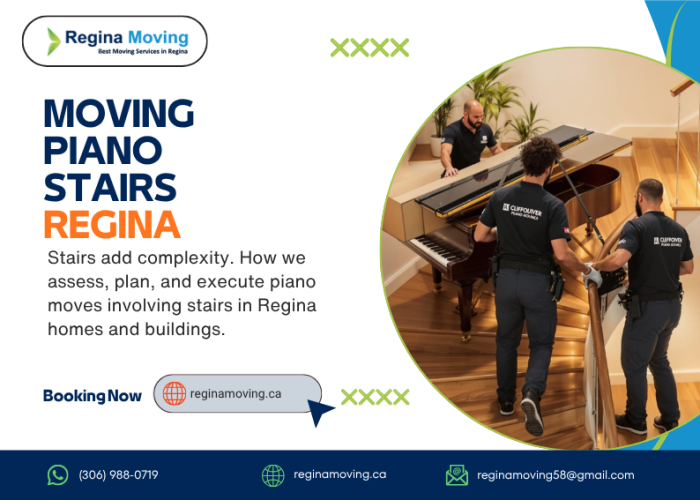
Ask any mover what they dread most, and “piano on a staircase” will be near the top of the list. Stairs multiply the difficulty of any piano move—they add weight, risk, and require a level of coordination that only experienced crews possess. In Regina, where many homes have narrow, winding staircases, moving piano stairs Regina is a skill we’ve perfected over thousands of moves.
At Regina Moving, we’ve moved pianos up and down every kind of staircase: straight flights, spiral stairs, tight basement steps, and even outdoor stone staircases. We use specialized equipment and trained crews to make sure your piano—and everyone involved—stays safe. Here’s how we do it.
to know more about moving different piano types regina visit our complete guide
Why Stairs Make Piano Moving Dangerous
A piano on level ground is heavy but manageable. A piano on stairs becomes a physics problem.
- Increased effective weight: When a piano is tilted on an incline, the perceived weight on the lower movers increases dramatically. A 600‑lb upright can feel like over 800 lbs on a steep staircase.
- Narrow spaces: Many Regina staircases are less than 30 inches wide, leaving no room for error. A slip or mis‑angle can result in damage to the piano, the walls, or the movers.
- Turns and landings: A staircase with a 90‑degree turn requires the crew to pivot the piano mid‑flight—a maneuver that demands precise timing and communication.
- No margin for error: On stairs, there’s no “set it down and regroup.” Once the piano is on the steps, it must be controlled every inch of the way.
These factors are why we never recommend a DIY piano move involving stairs. Even with several strong friends, the lack of proper equipment and training creates a high risk of injury and damage.
How Regina Moving Handles Stairs – Step by Step
We approach every stair move with a plan that starts well before the moving day.
Step 1: Assessment
We measure the stair width, the angle of the flight, and any landings or turns. We also check for protruding banisters, low ceilings, and the condition of the steps themselves.
Step 2: Equipment selection
Based on the staircase, we choose the right tools. For most straight flights, we use stair rollers—a dolly system with a track that lets us walk the piano up or down one step at a time. For narrow or winding stairs, we may use a combination of straps and a specialized stair‑climbing dolly.
Step 3: Preparation
We wrap the piano with heavy padding, paying extra attention to corners and the bottom edge. We also pad the stair railings and walls to prevent scuffs.
Step 4: Crew positioning
We assign 3 to 5 movers depending on the piano size. One person is positioned below the piano to guide and control the descent; others are above and on the sides to balance and support.
Step 5: Controlled movement
Using the stair rollers, we move the piano one step at a time. The crew communicates constantly (“ready, lift, step”). We pause frequently to check stability and adjust the angle if needed.
Step 6: Landings and turns
If the staircase has a landing, we transition the piano onto a flat dolly to reposition, then back onto stair rollers for the next flight. For turns, we use pivoting techniques that keep the piano balanced while changing direction.
Step 7: Safety stops
Throughout the move, we have predetermined safety stops where we reset our grip and reassess. No one moves until everyone is ready.
Cost of Moving a Piano with Stairs – What to Expect
Stair work adds time and requires additional crew, which is reflected in the cost. However, at Regina Moving, we include stair charges in your upfront quote—you’ll never see a surprise per‑flight fee.
Below are typical stair‑related costs added to the base piano move:
| Stairs | Additional Cost |
| 1 flight (straight) | $100 – $200 |
| 2–3 flights | $200 – $400 |
| 4+ flights or spiral staircase | $400 – $600+ |
These are estimates. Exact cost depends on piano size, staircase complexity, and accessibility. We provide a firm quote after an in‑home assessment.
DIY Stair Moves – Never Worth the Risk
We’ve seen the aftermath of DIY stair moves: pianos with cracked cases, torn‑out walls, and even injuries. Here’s a real example from a Regina resident:
“A few years ago, a homeowner tried to move an upright piano down a straight flight of stairs with four friends. They had no stair rollers—just a dolly and some straps. Partway down, the dolly slipped, the piano tipped, and one friend was pinned against the railing. The piano ended up with a cracked soundboard and the homeowner paid thousands in repairs.”
That outcome is all too common. Professional piano movers don’t just bring muscle—we bring the right equipment and, more importantly, the experience to use it safely.
Don’t Risk Stairs – Trust Regina Moving
Stairs are the ultimate test of a piano mover’s skill. At Regina Moving, we’ve passed that test thousands of times, with a zero‑claim record to show for it. Whether your piano is in a basement, on a second floor, or in a heritage home with a winding staircase, we have the equipment and the expertise to get it out safely.
Contact us today for a free in‑home assessment. We’ll evaluate your stairs, your piano, and give you a transparent quote—so you can move with confidence.
[Get Your Free Piano Moving Quote]
Frequently Asked Questions
Can a piano be moved up a narrow staircase?
Yes, if the staircase is measured first and the right equipment is used. Stair rollers and a properly padded piano allow us to navigate even narrow flights.
How many movers are needed for a piano on stairs?
At least three, but often four or five, depending on the piano size and staircase complexity.
Does moving a piano up stairs cost more than moving it down?
Typically the cost is similar—both require the same equipment, crew size, and risk management.
What if my staircase has a turn or landing?
We assess those in advance. With proper planning and pivoting techniques, we handle turns and landings safely.
Is it safe to move a grand piano on stairs?
Yes, when done by professionals. Grand pianos are placed on skid boards and then moved using stair rollers, with an experienced crew controlling the angle and weight distribution.
