
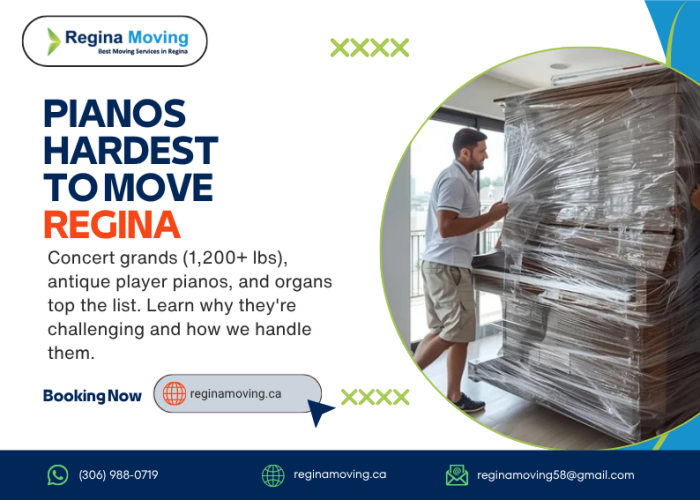
Some pianos are heavy. Some are awkward. And a few combine weight, fragility, and complexity into what movers call “the hard ones.” If you’re wondering whether your piano falls into that category, you’re not alone. Knowing which pianos are hardest to move helps you prepare for the logistics—and the cost—before the truck arrives.
At Regina Moving, we’ve handled more than 24,000 moves across Regina and Saskatchewan, and we’ve built a zero‑claim record by taking on the toughest instruments. Concert grands, antique player pianos, organs, and grand pianos in tight spaces top the list. Here’s why they’re challenging and how we make them look easy.
Know more about moving different piano types
Concert Grand Piano: The Ultimate Challenge
The concert grand is the heavyweight champion of piano moving. Weighing anywhere from 900 to over 1,200 pounds and stretching 7 to 9 feet in length, this is the kind of piano you typically find on a concert stage, in a church sanctuary, or in the home of a serious pianist.
Why it’s the hardest:
- Size and weight: Requires a crew of at least five movers, often more.
- Custom equipment: Legs must be removed, and a custom‑sized skid board is essential.
- Value: Concert grands can be worth $100,000 to $200,000 or more—mistakes are not an option.
- Venue logistics: Many concert grands are moved from stages with limited access, staircases, or loading docks.
How we handle it:
We start with a detailed site assessment, measuring every doorway and hallway. The piano is carefully disassembled (legs, pedals, and sometimes the lid), then strapped to a reinforced skid board. The crew uses a combination of piano dollies, stair rollers, and muscle—but the real secret is experience. We’ve moved concert grands for churches, music festivals, and private collectors across Regina, always with a zero‑claim outcome.
Antique Player Pianos: Fragile and Irreplaceable
Antique player pianos are a different kind of challenge. They typically weigh between 600 and 1,000 pounds, but the difficulty comes from their delicate internal mechanisms and irreplaceable materials.
What makes them so challenging:
- Internal components: Pneumatic systems, leather bellows, and motors are easily damaged by jarring or tilting.
- Fragile exteriors: Many have ornate carvings, mother‑of‑pearl inlays, or veneers that can chip or crack.
- Irreplaceability: If a modern part breaks, you can order a replacement. If a 100‑year‑old player‑piano mechanism breaks, it may be gone forever.
Our process for player pianos is deliberately slow. We use extra padding around every protruding detail, and we move at a pace that minimizes vibration. Climate control is also critical—sudden temperature shifts can crack aged wood or affect the internal pneumatic system. We treat these pianos as the historical artifacts they are.
Organs: Awkward Shape and Multiple Components
Organs often get lumped into “piano moving,” but they deserve their own category. Whether it’s a large digital church organ or a vintage home organ, they present unique obstacles.
Common organ moving challenges:
- Awkward dimensions: Many organs are tall and shallow, making them harder to balance on a dolly.
- Multiple pieces: A pipe organ may have separate cabinets, speakers, and pipes that need careful labeling.
- Electrical sensitivity: Organs with built‑in amplifiers and wiring require protection from moisture and impact.
We’ve moved organs for Regina churches, community halls, and private homes. Our approach includes documenting every piece, padding each component individually, and ensuring reassembly is seamless.
Grand Pianos in Tight Spaces: Precision Required
Even a “standard” grand piano becomes a hard move when the space is tight. Regina has many older homes with narrow hallways, sharp corners, and small elevators. Navigating a 6‑foot grand through a 29‑inch doorway requires precision—not force.
Key difficulties:
- Doorway clearances: A grand on a skid board needs enough width and height to angle through.
- Turns: Hallway corners may require the piano to be “walked” around using pivoting techniques.
- Small elevators: If the piano is in a high‑rise, we measure the elevator interior and door opening before we commit.
We solve these with careful measurement during the pre‑move assessment and by using a crew that knows how to pivot a skid‑boarded grand with inch‑by‑inch control.
Full Upright Pianos with Stairs: Weight + Angle
A full upright piano (500–900 lbs) on a staircase is one of the most dangerous moves we do. The combination of height, weight, and gravity can turn a simple staircase into a serious hazard.
Why stairs make uprights so hard:
- Center of gravity: Uprights are tall and top‑heavy; tilting them on stairs requires constant balance.
- Narrow stairwells: Many Regina homes have stairs less than 30 inches wide, leaving little room for error.
- Crew coordination: We use at least three or four movers, with one person positioned below to guide.
Our stair‑specific equipment—stair rollers and heavy‑duty straps—allows us to walk the piano up or down one step at a time, with frequent safety stops.
Trust Regina Moving with Your Most Challenging Piano
If your piano falls into one of these categories, don’t gamble with inexperienced movers or a DIY attempt. Regina Moving has the equipment, crew size, and hands‑on experience to handle the hardest pianos safely. We offer free in‑home assessments where we’ll evaluate your piano, the access points, and give you a clear quote—no surprises.
[Get Your Free Piano Moving Quote]
Frequently Asked Questions
What’s the hardest piano to move?
Concert grands and antique player pianos are generally the most challenging due to size, weight, and fragility.
Can a concert grand be moved without disassembly?
No. Legs must be removed and a skid board used. Partial disassembly (like the lid) is sometimes needed.
How many movers are needed for a concert grand?
At least five trained professionals—more if stairs or complicated access is involved.
Does Regina Moving have experience with these?
Yes. With over 24,000 moves, we’ve handled concert grands, antique player pianos, organs, and every other hard‑to‑move piano in Regina and beyond.
How do you protect an antique piano during a move?
Extra padding, slow handling, climate‑controlled transport, and pre‑move documentation ensure it arrives in the same condition as when we started.
