
Office moving and residential moving might seem similar, but they are completely different processes. One focuses on protecting memories. The other focuses on protecting revenue. If you’re planning a relocation in Regina, understanding these differences saves you time, money, and stress. Business moves require specialized equipment, after-hours scheduling, and IT coordination. Home moves need careful handling of personal belongings and emotional support. Let’s break down exactly how they differ so you can choose the right approach for your situation.
Purpose and Priorities Behind Each Move Type
A home move is deeply personal. You’re relocating memories—your child’s first drawings, grandma’s antique vase, the couch where you watched movies for years. The priority is protecting sentimental items and keeping stress low for your family . Residential moves focus on comfort, familiarity, and making a new space feel like home. Families usually have flexibility with moving dates and can adjust timelines if needed.
An office move, however, is business-critical. Every hour of downtime costs money. Employees can’t work. Clients get frustrated. Deals get delayed . The priority here is speed, coordination, and seamless execution. Commercial moves involve multiple stakeholders—managers, IT teams, building management, and sometimes client expectations . The goal isn’t just moving items; it’s resuming normal operations as fast as possible with zero disruption.
This fundamental difference shapes everything that follows: planning timelines, equipment needs, and who handles the move.
Planning Complexity and Coordination
Planning a home move is straightforward. You coordinate with your family, book movers, and pack at your own pace. Most residential moves require 4–8 weeks of preparation. You sort through belongings, decide what to donate, and arrange utilities at your new place . Communication flows through one or two decision-makers. Changes are easy to manage.
Office moves are completely different. Here’s why:
- Multiple departments must align (HR, IT, operations, leadership)
- Building protocols at both locations require approval
- IT infrastructure needs pre-move setup and testing
- Employee communication plans keep everyone informed
- Vendors must coordinate delivery and installation dates
- Security protocols protect confidential data during transit
The result? Commercial moves need 3–6 months of planning. Project managers oversee timelines, budgets, and contingency plans. Without this structure, businesses risk extended downtime and unexpected costs . A residential move checklist helps families stay organized. An office relocation checklist keeps companies operational.
Equipment, Belongings, and Handling Requirements
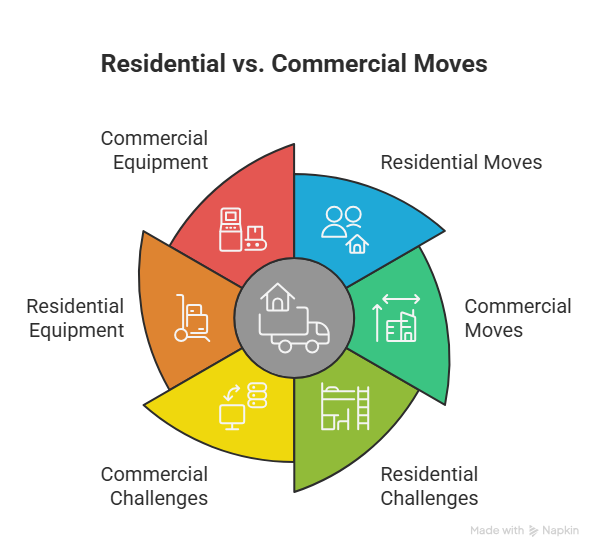
Residential moves involve familiar items. Sofas, beds, dressers, kitchen tables, TVs, and personal boxes. Movers use standard equipment—dollies, furniture blankets, and moving straps. Most household items fit through doorways without disassembly. The biggest challenges? Protecting fragile dishes, navigating stairwells, and fitting large furniture through tight spaces .
Office moves require specialized handling. Consider what businesses relocate:
- Modular cubicles needing disassembly and reassembly
- Heavy filing cabinets full of documents
- Servers and IT racks with sensitive data
- Conference room AV equipment
- Specialized machinery or lab equipment
- Medical devices needing sterile transport
Commercial movers use different tools: IT-safe packaging, tamper-proof containers for confidential files, equipment lifts for heavy items, and climate-controlled trucks for sensitive technology . Your grandma’s china and your company’s server rack cannot be moved the same way.
Timing, Downtime, and Scheduling Flexibility
Residential moves offer schedule flexibility. Most families move on weekends or month-ends to avoid missing work or school . If packing takes an extra day, it’s inconvenient but not catastrophic. You control the timeline based on closing dates and personal availability.
Office moves run on strict deadlines. Here’s what businesses prioritize:
- Moves happen after hours, on weekends, or during holidays
- Employees arrive Monday morning to a fully functioning office
- IT systems go dark Friday night and reboot Saturday morning
- Every hour of downtime equals lost revenue
- Building management enforces strict move-in windows
The difference is night and day. Home movers ask, “When works for you?” Office movers ask, “How fast can we get you running?” . This is why professional office movers in Regina offer 24/7 support and weekend scheduling—businesses cannot afford to pause operations.
Cost Structure and Quote Transparency
Residential moving costs are straightforward. You pay for truck size, number of movers, distance, and time. Additional fees may apply for stairs, long carries, or bulky items. Most homeowners receive simple hourly or flat-rate quotes . The final price depends on how much stuff you own and how far you’re going.
Office moving quotes involve more variables. Commercial movers assess:
- Dismantling and reassembling modular furniture
- Special handling for IT equipment
- Floor plan setup at the new location
- After-hours labor rates
- Potential storage needs during transition
- Insurance for high-value business assets
Reputable commercial movers provide transparent quotes with no hidden fees. At Regina Moving, we walk you through every line item so you know exactly what to expect. No surprises. No last-minute charges .
Why Regina Moving Excels at Both Services
We understand both worlds. With 12+ years serving Regina families and businesses, we know what each move demands . Our residential teams treat your home with respect—wrapping furniture carefully, protecting floors, and listening to your concerns. Our commercial crews arrive with project plans, specialized gear, and IT expertise.
Here’s what sets us apart:
- Zero claim rate means your items arrive safely
- 54k+ successful moves prove our reliability
- 24/7 phone support so you reach us anytime
- Transparent pricing with no hidden fees
- Weekend and after-hours scheduling for businesses
Whether you’re moving your family across Regina or relocating your office across the province, you get the same care, communication, and commitment. That’s why customers call us Regina’s most trusted movers .
Ready to Plan Your Next Move?
Don’t let confusion cost you. Now you understand the key differences between office moving vs residential moving. Home moves protect memories. Office moves protect revenue. Each requires the right expertise, equipment, and approach.
At Regina Moving, we deliver both. Our team handles your corporate relocation with the precision your business deserves—minimal downtime, careful IT handling, and seamless setup. Local businesses trust us because we treat their success like our own.
👉 Book Your Office Move Date Today and get a transparent quote with no hidden fees. Let’s make your transition smooth, safe, and stress-free.
Top 5 FAQs About Office vs Residential Moving
1. Can the same moving company handle both my home and office move?
Yes, many full-service movers offer both residential and commercial services. However, confirm they have experience with office equipment and IT setups before booking .
2. How far in advance should I book an office move?
Plan at least 3–6 months ahead for commercial moves. Residential moves typically need 4–8 weeks of notice .
3. Do office movers handle computer and server relocation?
Professional commercial movers do. They use anti-static materials, backup protocols, and careful handling to protect your data and hardware .
4. Is office moving more expensive than residential moving?
Generally yes, because of specialized equipment, after-hours labor, and project coordination. However, transparent quotes help you budget accurately .
5. What’s the biggest mistake businesses make when moving?
Waiting too long to plan. Rushed office moves lead to downtime, lost equipment, and frustrated employees .
